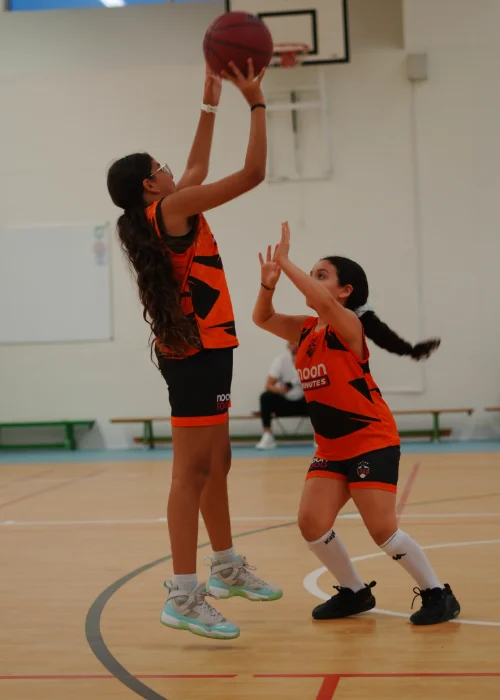
A Basketball Player Is Built Through Connected Skills
A strong basketball game does not appear from one drill, one season or one natural ability. It develops through layers. A girl learns to control the ball, then control it while moving. She learns a passing technique, then recognises when and where to pass. She practises shooting, then works to maintain balance and judgement under pressure.

“Build her game” describes a process rather than a quick transformation. The foundation must be clear, repetitions must have purpose and new challenges must arrive at an appropriate time. The player should understand not only how to perform a movement but why it matters in basketball.
For parents comparing girls’ basketball training in Dubai, this process is more important than a session that merely looks energetic. Quality development connects weekly activities into a curriculum and gives every player a realistic next step.
Star Sport Academies offers structured girls-only basketball for ages 4–18 in Dubai. The approved programme spans complete beginners through competitive players, with skills taught step by step and progression into real games when players are ready.
Development Starts With the Player’s Current Level
Age is an important guide, but it does not tell the whole story. Two girls of the same age may have very different experience, coordination, confidence and understanding. A good coach observes the individual before deciding how to challenge her.
A complete beginner needs to become comfortable with the ball, court and basic rules. An experienced player may need more pressure, faster decisions or tactical responsibility. Giving both girls the same task in exactly the same form may leave one overwhelmed and the other unchallenged.
Coaches can adjust difficulty through space, time, defender pressure, rules, equipment and individual goals. Both players can work on ball handling, for example, while one develops basic control and the other must change pace against an active defender.
This is why a trial can be useful. It lets coaches see the player in action and recommend a group based on real evidence, while the family assesses whether the environment fits.
Ball Handling: Control Before Complexity
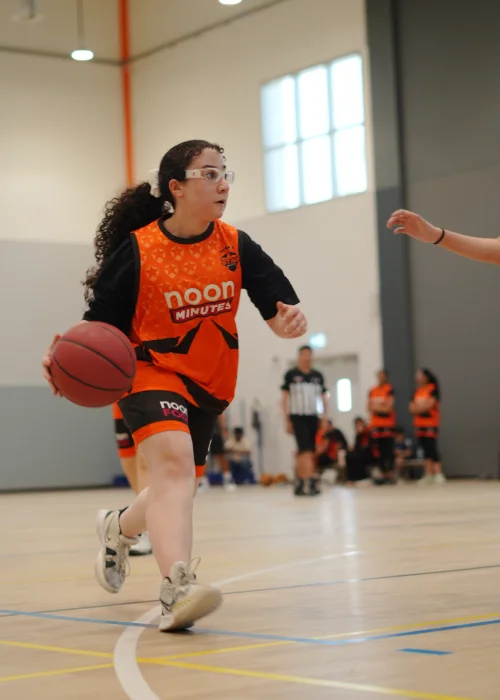
The dribble allows a player to move with possession. Early ball-handling work should create familiarity with either hand, different heights and controlled changes of direction.
Players may begin by developing:
- balanced stance and posture;
- fingertip control rather than striking with the palm;
- comfort using the non-dominant hand;
- awareness while the ball is moving;
- changes of pace and direction; and
- protection from a defender.
Stationary exercises can introduce movement patterns, but basketball requires travel and decisions. Training should progress into dribbling through space, reacting to cues and managing defenders.
Advanced moves have value only when they solve a problem. A crossover should create separation, not become a performance with no awareness of the court. Coaches help girls understand which change suits the defender’s position and what action should follow.
Turnovers are part of learning. The goal is not to protect players from losing the ball forever, but to help them recognise why control failed and attempt a more effective solution.
Passing and Catching: Building Team Possession
Passing transfers both the ball and responsibility. A player must consider distance, angle, defender position, teammate movement and timing.
Girls can learn chest, bounce, overhead and one-hand passes where age and context make them appropriate. Technique includes balance, direction and suitable force. Catching requires ready hands, attention and control into the next action.
Passing drills should evolve beyond two stationary lines. Adding movement and defenders turns the technique into basketball. Players must create a passing lane, meet the pass, use a pivot or decide that a different option is safer.
Coaches can emphasise passing ahead to reward teammates who run, making the extra pass to improve a shot and avoiding risky delivery across active defenders.
Communication supports the skill. Names, targets and eye contact help connections. Girls learn that a technically accurate pass can still be a poor decision if it places a teammate under unnecessary pressure.
Footwork: The Foundation Under Every Action
Basketball footwork is easy to overlook because attention follows the ball. Yet balance, stops and pivots influence almost every possession.
A player needs to stop under control, establish legal foot position and protect the ball. She uses pivots to see options and escape pressure. On offence, changes of direction help her get open. On defence, lateral movement and controlled recovery help her remain effective without reaching recklessly.
Footwork also supports shooting. Poor balance or rushed alignment can make upper-body corrections inconsistent. Coaches can teach the feet and hands as parts of one coordinated movement.
For younger girls, footwork may be introduced through varied movement games and simple stops. Older or experienced players can apply it at greater speed, against opposition and within position-specific situations.
Good training gives footwork meaning. Players learn where the movement takes them and what advantage it creates.
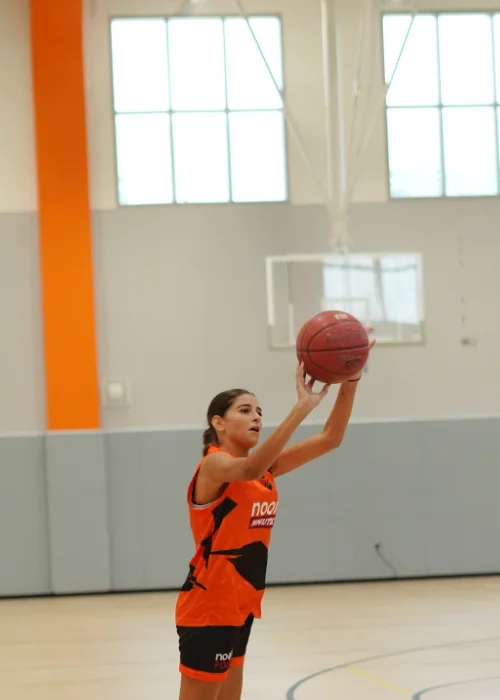
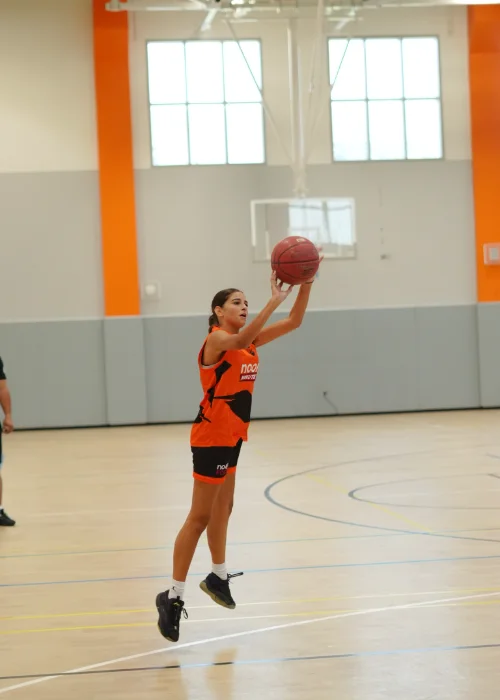
Shooting: Technique, Repetition and Decision
Shooting attracts attention because it produces points, but sustainable development requires more than taking many attempts.
Foundational shooting includes a stable base, coordinated movement, appropriate hand placement, visual focus and a controlled follow-through. Equipment and distance should allow the player to use sound mechanics. Forcing a young girl to shoot too far can create compensations that become difficult habits.
Repetition matters, but quality and feedback matter too. A coach can identify one adjustment and provide another attempt. Video may sometimes help older players, but clear in-person observation remains essential.
Shooting development should progress from controlled form to game context. Girls learn to prepare before receiving, stop with balance, shoot after movement and respond to a defender. They also learn shot selection: an available attempt is not always the best team decision.
Finishing near the basket includes both hands, different angles and protection from pressure. Confidence grows when players have practised realistic solutions rather than relying on one preferred move.
Movement Without the Ball
Only one player holds the ball, so most basketball participation happens without it. Girls need to learn how movement creates options.
They may practise getting open, cutting into space, replacing positions and maintaining useful spacing. Screens can be introduced with careful attention to legal, safe technique and the actions that follow.
Young players often move toward the ball because they want involvement. This can crowd the court. Coaches use simple visual references and small-sided games to show why space helps the player in possession.
Off-ball movement also develops patience. A girl may create an advantage for a teammate without receiving the pass herself. Recognising that contribution helps players move beyond the idea that value depends on individual possession.
As tactical understanding grows, movement becomes connected to reads. A player cuts because a defender turns her head, not only because a coach memorised a route for her.
Defence: Skill, Discipline and Team Responsibility
Defence should be taught as a collection of skills, not simply a demand to try harder. Effort matters, but efficient stance, angles, timing and communication make effort more useful.
Players learn to position themselves between an opponent and a valuable area, move laterally with balance and recover when beaten. They use active hands without reaching carelessly. They understand how to contest while respecting rules and safety.
Off-ball defence adds awareness. A girl needs to see both her opponent and the ball, provide help and recover. The team must communicate screens, switches and matchups at a level appropriate to the group.
Defensive training can build resilience because success often requires repeated action. One good stop may be followed immediately by a rebound contest or loose ball. Girls learn to complete the possession rather than relax after the first effort.
Coaches should reward disciplined defence, not only dramatic steals. Chasing the ball can look active while damaging team structure.
Rebounding: Reading, Positioning and Commitment
A missed shot creates an uncertain moment. Rebounding teaches players to anticipate, establish position, pursue the ball and secure possession.
Height can help, but technique and timing matter. Girls can learn to identify an opponent, create legal contact where appropriate, maintain balance and move toward the rebound rather than waiting underneath it.
Once the ball is controlled, the next decision begins. The rebounder protects possession, looks for an outlet or begins the transition according to the team’s principles.
Rebounding is valuable for development because it connects physical commitment with awareness. It also offers a meaningful team contribution that does not depend on scoring.
Training should avoid unsafe collisions. Coaches establish spacing, controlled progression and clear rules before increasing intensity.
Physical Skills Should Support Basketball
Basketball demands acceleration, deceleration, changes of direction, jumping, landing and repeated movement. Physical preparation should make these actions more effective and responsible.
Younger girls benefit from broad coordination, balance and movement confidence. As players mature, training can include age-appropriate strength, speed and repeated-effort work that reflects their experience and total activity.
Movement quality is more important than punishment exercise. Coaches can teach girls how to land, stop and change direction under control. Conditioning can be integrated into basketball activities or planned with a clear purpose rather than used after mistakes.
Players also learn preparation habits: appropriate warm-up, hydration, recovery and communication about pain. Relevant health concerns should be shared with the academy, while diagnosis and treatment require qualified medical professionals.
Development varies through growth. Temporary changes in coordination are normal and should not be treated as lack of effort.
Game Understanding Connects Every Skill
Technical ability becomes useful when a player can read the situation. Game understanding includes spacing, timing, advantage, transition and awareness of score or time at an appropriate level.
Coaches can develop understanding through small-sided games because fewer players create more decisions and involvement. Rules may emphasise a theme, such as using width, making an extra pass or recovering quickly on defence.
Questions encourage reflection:
- What did the defender take away?
- Where was the open space?
- How could the team create a better passing angle?
- What changed after possession was lost?
- Was the first shot the best shot?
The aim is not to make girls recite tactical vocabulary. It is to help them see patterns soon enough to act.
As players progress, team concepts can become more complex. Fundamentals remain underneath them: control, awareness, movement and communication.
Why Small-Sided Games Accelerate Learning
Full five-on-five basketball is essential, but it can hide developing players. A girl may spend several possessions with limited contact or decision-making.
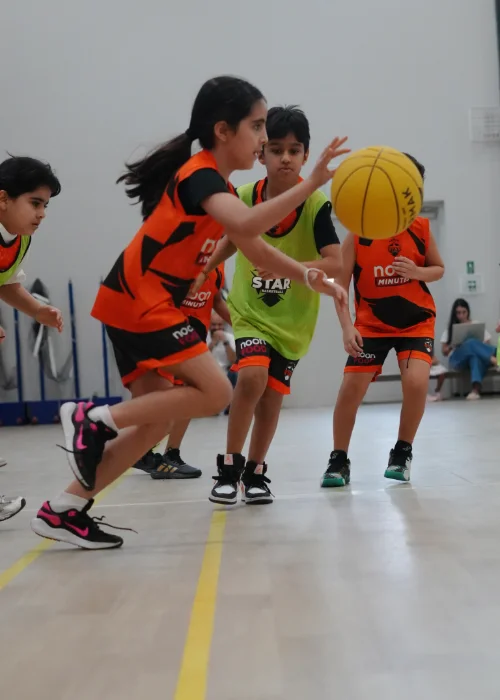
One-on-one, two-on-two and three-on-three formats increase involvement. Players repeatedly attack, defend, transition and communicate. Space is easier to understand because fewer relationships occur at once.
Coaches can use small-sided games to teach a specific problem. Two-on-two may highlight passing and cutting. Three-on-three can introduce help defence and spacing. Rules can reward the target behaviour without removing choice.
These games also make ability visible. Coaches see which players scan, protect the ball or understand support. Feedback becomes connected to realistic action.
Small-sided play should not become constant uncontrolled competition. A clear objective, suitable space and brief reflection keep the activity educational.
Feedback Turns Repetition Into Improvement
Practice without attention can repeat errors. Feedback helps players understand what to preserve and what to adjust.
Effective coaching feedback is specific, timely and limited enough to use. “Keep your eyes up” may be useful, but “look before your second dribble so you see the help defender” is more connected to the game.
Players need another attempt after correction. Otherwise, information remains theoretical. Coaches should also recognise improvement, helping girls understand that the adjustment worked.
Not every action needs intervention. Over-coaching can make a player afraid to decide. Sometimes the coach observes several repetitions, asks a question or allows the game to continue until a natural pause.
Older or experienced players can become more involved in reflection. They may identify their own priority and review whether it appeared in games. This builds ownership rather than dependence.
Progression Must Be Earned and Explained
Moving into a more advanced group or competitive role can motivate players, but progression should be responsible.
Readiness may include technical execution, decision-making, physical capacity, attendance, behaviour and ability to handle the demands of the next environment. One high-scoring game should not outweigh the broader evidence.
Coaches should explain priorities constructively. A player who is not ready for a move needs a path forward, not a vague label. Specific targets—such as protecting the ball under pressure or improving defensive awareness—give her something she can influence.
Girls also progress within a group. A new role, increased responsibility or more consistent performance can be meaningful even when the group name does not change.
Star’s approved positioning describes progression from complete beginner to competitive player. Families should ask how this pathway operates for the current season and which real-game opportunities apply.
Measuring Development Beyond Points
Points are easy to count but can distort evaluation. A player may score more because she takes many shots, while another improves the team through decisions that do not appear in a simple statistic.
Useful signs of progress include:
- controlling the ball with either hand;
- scanning before dribbling;
- making accurate passes under pressure;
- preparing feet before receiving;
- choosing better shots;
- creating space without the ball;
- communicating defensively;
- boxing out and securing rebounds;
- transitioning quickly; and
- recovering constructively after mistakes.
Parents can ask what the current coaching theme is and watch for that behaviour. This keeps attention connected to learning rather than comparison.
Progress will not be linear. Growth, school pressure, illness, new groups and stronger opposition can affect visible performance. Patterns across time provide better evidence than one session.
How Parents Can Support Skill Development
Parents do not need to become basketball coaches. Their most valuable contribution is often consistency and perspective.
Help your daughter attend prepared and on time. Encourage simple practice if she enjoys it, but avoid turning home into another compulsory session. Let academy coaches provide the main technical language so she does not receive conflicting instructions.
After training, ask what she worked on rather than whether she was the best. After games, allow emotion to settle before analysis. Praise preparation, decision-making and response to difficulty.
Avoid demanding a group move or position based only on comparison. Ask coaches about the evidence and development plan. Honest collaboration supports the player better than pressure from competing adults.
As she matures, transfer responsibility for equipment, goals and communication gradually to her.
What to Look for in Girls’ Basketball Training in Dubai
During a trial, observe the learning environment:
1. Are girls active and receiving frequent touches? 2. Does the session have a clear theme? 3. Do activities progress from technique toward decisions? 4. Can coaches adjust for different levels? 5. Is feedback specific and respectful? 6. Are players allowed to think and solve problems? 7. Does small-sided play connect to full basketball? 8. Are defence, movement and teamwork taught—not only shooting? 9. Is progression explained realistically? 10. Are safety and organisation professional?
Ask about group placement, training frequency, season structure, games and how feedback is communicated. Practical fit matters because regular attendance gives coaching time to work.
Girls-Only Basketball Development for Ages 4–18
Star Sport Academies offers structured girls-only basketball training for ages 4–18 in Dubai. The approved programme describes shooting, ball handling, movement and game understanding coached step by step, with individual feedback and development from beginner to competitive player.
Specific groups, venues, times, fees and competition schedules should be confirmed directly with Star. A trial lets the academy recommend an appropriate entry point and lets the player experience how the coaching feels.
She does not need every skill before she joins. She needs a suitable place to begin, instruction she can understand and enough time to build.
Build the Skill, Then Build Its Use
Basketball development works when technique and decisions grow together. A girl learns the dribble, then uses it to create space. She learns the pass, then recognises the teammate who has an advantage. She learns shooting mechanics, then prepares those mechanics at game speed.
Each layer makes the next one possible. Clear coaching creates direction. Repetition creates familiarity. Pressure tests whether the skill is adaptable. Games reveal what to practise next.
Building her game is therefore not a race to collect advanced moves. It is a patient process of creating reliable tools and teaching her how to choose among them.
Book a Girls’ Basketball Trial in Dubai
Let your daughter experience step-by-step basketball development in a girls-only programme. Contact Star Sport Academies for current information and request a trial for ages 4–18 in Dubai.
Explore the Girls’ Basketball programme, check the basketball locations and timetable, or book a girls’ basketball trial.
Current Supplied Venues
Basketball network
- Al Barsha
- RIT–DSO
- Ashmount School
- Jumeirah–JBS
- Mirdif Uptown School
- Al Khaleej Al Warqa
- South School
- Sharjah
- Al Qusais
Please note: These locations belong to Star’s wider basketball network. Contact Star to confirm which venues currently host girls-only basketball groups, age groups and trial sessions.
Frequently Asked Questions
Which basketball skills should beginners learn first?
Beginners need balanced movement, ball familiarity, basic dribbling, passing, catching, shooting foundations, defensive stance and simple court awareness.
Can an experienced player still benefit from fundamentals?
Yes. Advanced development applies fundamentals at greater speed, pressure and tactical complexity. Reliable basics support every competitive level.
Does Star accept complete beginners?
The approved programme describes development from complete beginner to competitive player for girls aged 4–18, subject to suitable current group availability.
How are girls moved into more advanced groups?
Families should ask Star about the current process. Responsible progression considers sustained technical, tactical, physical and behavioural readiness rather than one performance.
Are real games part of skill development?
Yes. Star’s approved positioning includes progression into real games and competition when players are ready. Games test whether training skills transfer under pressure.
How quickly can a girl improve her shooting?
Timing varies with age, starting technique, practice quality and consistency. Sound mechanics should be developed progressively rather than rushed for short-term distance.
What should parents evaluate during a trial?
Look for clear objectives, high involvement, step-by-step progression, useful feedback, appropriate challenge, decision-making and professional safety standards.